
Traditions · The journal
Despacho Ceremony and the Meaning of Ayni
Understand an Andean offering through reciprocity, community work, and relationship with Pachamama, with respectful questions for a first visit.
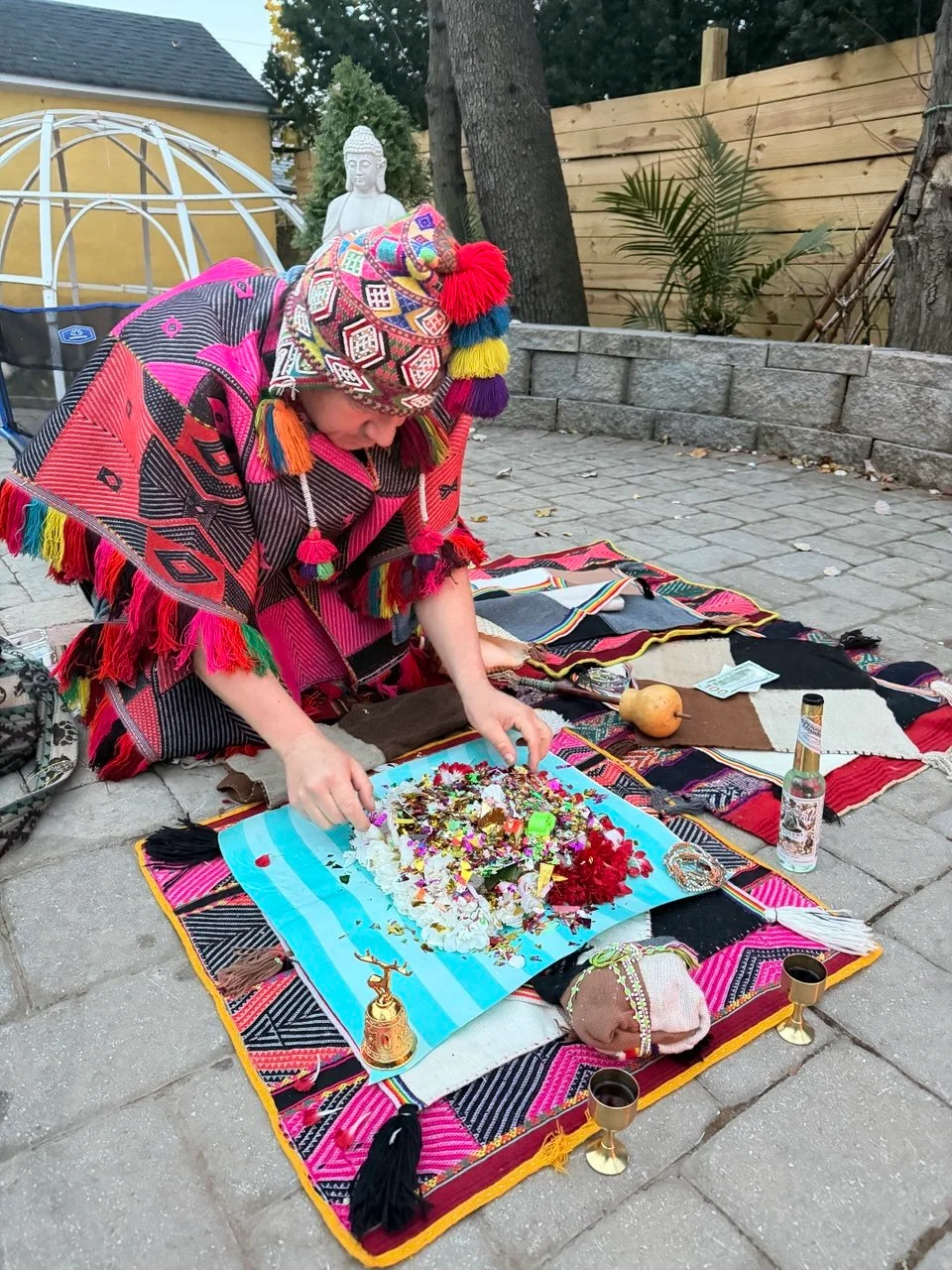
An offering is more than its appearance
A despacho is an Andean ceremonial offering. It can be approached through questions of gratitude, responsibility, and relationship with Pachamama, often translated as Mother Earth. The arrangement is visible; the relationships that give it meaning may be much less obvious to a visitor.
There is no reason to assume that every offering called a despacho has the same purpose or form. The Peruvian Ministry of Culture’s Aimara profile, for example, describes an ayta or despacho connected with planting potatoes. It places the practice among agricultural and pastoral relationships with Pachamama, rather than presenting it as a free-standing exercise in personal wish-making.
That example helps orient a first question: What relationship or occasion is this particular offering addressing? The answer matters more than memorizing a list of objects.
Ayni means reciprocity, not just gratitude
The Smithsonian’s National Museum of the American Indian explains ayni as ongoing cycles of reciprocity involving comparable work or goods. Its emphasis is on relationships that continue over time. Ayni is not simply another word for feeling thankful.
The Ministry of Culture likewise describes reciprocal labor within Aimara communities. Ayni appears alongside other named forms of collective work. This social context is important: the concept belongs to how people sustain life together, not only to the language of ceremony.
For a visitor, a useful distinction is between appreciation and obligation. Appreciation asks, “What have I received?” Reciprocity adds, “What relationship am I now responsible for tending?” That is a way to reflect on the sources, not a claim that one English sentence captures every community’s understanding.
The connection between offering and everyday work
In its exhibition on the Inka Road, the Smithsonian describes communities maintaining sections of the road in the spirit of ayni. It also documents an offering to Pachamama and the apus after trail clearing at Machu Picchu.
The pairing is instructive. Practical work and ceremonial acknowledgment appear together. Neither needs to be reduced to an ornament around the other.
A photograph of an offering can miss that larger story: who did the work, whose place it is, what was received, and what responsibilities remain afterward. Looking beyond the finished arrangement makes a despacho easier to understand as a relationship rather than a spectacle.
It also suggests why paying for attendance, buying beautiful materials, or posting a photograph cannot by itself tell you whether reciprocity is being practiced.
Avoid turning a living practice into a template
The photograph accompanying this article shows one offering being arranged. It is not a universal pattern to copy, and a description on this website is not permission to lead someone else’s ceremony.
Before touching, adding to, or photographing an offering, ask the person responsible for it. Ask which explanations can be shared publicly and which belong within the gathering. You do not need to claim another person’s knowledge in order to value it.
It is also worth distinguishing a despacho from a mesa. An offering and a ceremonial altar can appear in related conversations without meaning the same thing. The Pachakuti Mesa guide introduces that distinction and explains why the modern named tradition should not stand in for all Andean practice.
Questions to bring to a despacho introduction
A few specific questions can open a much richer conversation than “What should I bring?”
- Whose teaching informs this offering? Ask about the relevant community, teacher, or family practice, and any contemporary adaptations.
- What is the occasion? Is the emphasis gratitude, a communal responsibility, a life transition, or something else the host can explain?
- How may a guest participate? Ask whether observing quietly is possible and what permission is needed before handling materials or taking photographs.
- What happens afterward? Ask who is responsible for the place, the materials, and leaving the site cared for.
- How does reciprocity continue? Look for a concrete answer about relationships and responsibilities, rather than a promise that an offering guarantees a desired result.
A good introduction should leave room for questions and for a respectful “not today.”
Carrying the question into ordinary life
You do not have to recreate a ceremony to consider what reciprocity asks of you. You might follow through on a commitment, help with shared work, or take better care of a place you regularly enjoy. These are everyday reflections, not substitutes for an Andean ritual or claims to ceremonial authority.
Our Despacho ceremony page offers an introduction to the subject. To understand the people sharing it here, start with the family’s story, then ask a question. Any published gatherings belong on the calendar; an educational article is not an event announcement.
Sources & further reading
This guide was created with AI assistance using the sources above. It provides educational context, not Oswal’s personal teachings or professional advice. Read our editorial approach or send a question or correction.